Like the title says, how likely is it to have a North American continent with many small nations instead of three big ones.
You are using an out of date browser. It may not display this or other websites correctly.
You should upgrade or use an alternative browser.
You should upgrade or use an alternative browser.
How likely is Balkanised America?
- Thread starter Adlaf Featherstan
- Start date
Like the title says, how likely is it to have a North American continent with many small nations instead of three big ones.
That really depends on what kind of POD you use.[/Captain Obvious to the rescue!]
I mean, seriously - if the POD is something that results in Britain being weaker during the 16th and 17th centuries (thus allowing various European nations, such as France, Spain, the Netherlands, and perhaps even some Scandinavian nations, to establish long-therm colonies on North America's west coast), then it's really easy to get a North America that's divided into many different nations.
However, if the POD is during the American Civil War, then (plausibly) getting a balkanized America will be a bit tricky...
Anaxagoras
Banned
A failed Constitutional Convention would also be a possible POD for a Balkanized North America.
A failed Constitutional Convention would also be a possible POD for a Balkanized North America.
Do you think the idea would be revisited in light of late 19th century nationalism?
I.E. a bunch of formerly-English colonies in North America see Italy and Germany unite and think "Why can't we do that too?" Could be an interesting TL. I've always been sort of interested to see what people think would've happened to Western North America if the United States hadn't expanded. Russia builds up her colonies? Britain? Japan?
Interestingly, we could see a TL like this leading to an independent Amerindian nation (something like the Iroquois Confederacy) in the center of the continent.
Federated or independent, I don't think the political structure of the ex-colonies will effect the expansion of the 'rugged individualists' that crossed the Appalachians into the Mississippi plain. The big question would be what happens to Louisiana (I don't think the French would have been able to hold it in the long run, so it may just fade away under the settlers feet), and the northern territories of Mexico (more problematic, but the individual states' armies might be more boisterous and unruly than a combined military force, leading to skirmish wars over the long term. Eventually an alliance to 'contain the Mexican problem').
Russia would probably be kept to the North Pacific by the British with the Vancouver colony and Oregon territory. I could see this being one large change, with a fair chunk of the Pacific coast and interior being incorporated into a independent Brit-colony - maybe even include the Sandwich islands one day.
Another change would be the Canada never forms - the Maritime Provinces may still confederate for economies of scale, but without the pressures of a powerful and militaristic USA to the south, they would likely not join with Upper and Lower Canada. Those two might either become close friends making up a bi-cultural major nation on the continent, or break down in to eternal squabbling - it could go either way.
The centre of the continent - Prairies and Upper Plains - might stay as lightly settled territories for a long time, without concerted pushes to 'settle or relinquish' from central governments. Maybe not independence, but substantial self-governance for Amerindians in those areas...
Russia would probably be kept to the North Pacific by the British with the Vancouver colony and Oregon territory. I could see this being one large change, with a fair chunk of the Pacific coast and interior being incorporated into a independent Brit-colony - maybe even include the Sandwich islands one day.
Another change would be the Canada never forms - the Maritime Provinces may still confederate for economies of scale, but without the pressures of a powerful and militaristic USA to the south, they would likely not join with Upper and Lower Canada. Those two might either become close friends making up a bi-cultural major nation on the continent, or break down in to eternal squabbling - it could go either way.
The centre of the continent - Prairies and Upper Plains - might stay as lightly settled territories for a long time, without concerted pushes to 'settle or relinquish' from central governments. Maybe not independence, but substantial self-governance for Amerindians in those areas...

Thande
Donor
That sounds like quite a good idea for a TL. Too often the failed-constitutional-convention idea seems to assume that America will stay forever separated, ignoring the fact that the shared language, heritage and interests might well re-spark unionism when 19th century nationalism comes along.Do you think the idea would be revisited in light of late 19th century nationalism?
I.E. a bunch of formerly-English colonies in North America see Italy and Germany unite and think "Why can't we do that too?" Could be an interesting TL. I've always been sort of interested to see what people think would've happened to Western North America if the United States hadn't expanded. Russia builds up her colonies? Britain? Japan?
Interestingly, we could see a TL like this leading to an independent Amerindian nation (something like the Iroquois Confederacy) in the center of the continent.
I'm thinking of doing that timeline, if anyone has any suggestions please do not hesitate to inform me of them
The likelyhood of several small nations rather than one large nation I think is great.
The OTL is less likely for many reasons. There were great pressures on the early post-revolutionary government, and it had significant potential for failure or disagreements amongts the included states.
However - to play devil's advocate.
Prior to the ACW and the resulting development of a stronger Federal Gov. What is now THe United States of America was - THESE United States of America.
Many sovergn "States" under one Union.
So in a sense there was a greater degree of individual sovierngess prior to ACW - more in keeping with the States ( countries) in the EU, or perhaps the Cantons of Switzerland.
The OTL is less likely for many reasons. There were great pressures on the early post-revolutionary government, and it had significant potential for failure or disagreements amongts the included states.
However - to play devil's advocate.
Prior to the ACW and the resulting development of a stronger Federal Gov. What is now THe United States of America was - THESE United States of America.
Many sovergn "States" under one Union.
So in a sense there was a greater degree of individual sovierngess prior to ACW - more in keeping with the States ( countries) in the EU, or perhaps the Cantons of Switzerland.

I'm thinking of doing that timeline, if anyone has any suggestions please do not hesitate to inform me of them
What I wonder is how English Canada may take this. Uniting them OTL came mostly with how powerful America became; take that away, and I can see most of the provinces staying seperate. Would they too be tempted to join the independent states below uniting?
back in the 1990s I wrote a TL just like the first paragraph below..the US broke up..splintered badly..but slowly reformed
Do you think the idea would be revisited in light of late 19th century nationalism?
I.E. a bunch of formerly-English colonies in North America see Italy and Germany unite and think "Why can't we do that too?" Could be an interesting TL. I've always been sort of interested to see what people think would've happened to Western North America if the United States hadn't expanded. Russia builds up her colonies? Britain? Japan?
Interestingly, we could see a TL like this leading to an independent Amerindian nation (something like the Iroquois Confederacy) in the center of the continent.
I suppose the idea just seems strange to Americans. I mean to us we can only think that "Americaa is Divided, bad!" and the whole unification things seems very... foreign.That sounds like quite a good idea for a TL. Too often the failed-constitutional-convention idea seems to assume that America will stay forever separated, ignoring the fact that the shared language, heritage and interests might well re-spark unionism when 19th century nationalism comes along.
@SRT: The amerindian idea is intriguing, but unfortunately (if we assume the USA does not have the Louisina Purchase in this TL) the central area you're thinking of is mostly depopulated. You have to best bets: A British backed Federation created by Tecumseh/Tenskwatawa in the Ohio territory, or a confederation of the varous civilized tribes of the south. The first one is more dependant on people, and therefore could be butterfly-killed, but the second requires a weak Carolina and georgia for it to work.
It'll be interesting to see what happens in Florida in this TL. The Seminoles will still exist, but the British or Spanish will still control it, we might get a Seminole dominated State in the late 19th century, or a plantation state with a massive Indian population, or a revolutionary nation in the 20th.
What I wonder is how English Canada may take this. Uniting them OTL came mostly with how powerful America became; take that away, and I can see most of the provinces staying seperate. Would they too be tempted to join the independent states below uniting?
If each US state had become a country, and if they were a success (IE, they were still countries, not colonies again) by the 1860's, then I could see each province of Canada deciding to become countries as well.
Suppose, that France applies the same policy in LousianaLike the title says, how likely is it to have a North American continent with many small nations instead of three big ones.
that Uk would apply in Australia - That is, to use it as a deposit of
malcontents... only in a much larger scale. Suppose many that would
Lousiana gets its independence even earlier than the USA, and
becomes a new , and prosperous nation....
Do you think the idea would be revisited in light of late 19th century nationalism?
I.E. a bunch of formerly-English colonies in North America see Italy and Germany unite and think "Why can't we do that too?" Could be an interesting TL. I've always been sort of interested to see what people think would've happened to Western North America if the United States hadn't expanded. Russia builds up her colonies? Britain? Japan?
Interestingly, we could see a TL like this leading to an independent Amerindian nation (something like the Iroquois Confederacy) in the center of the continent.
I agree with Thande and Umbric, though of course any such TL going into the later 19th Century will be so artificial that the writer will obviously be planning what he wants to happen. (Which doesn't mean it wouldn't be a great read.)That sounds like quite a good idea for a TL. Too often the failed-constitutional-convention idea seems to assume that America will stay forever separated, ignoring the fact that the shared language, heritage and interests might well re-spark unionism when 19th century nationalism comes along.
But another thing that, over time, supports a unified con-US is... geography. Like China, there are relatively few major geographic barriers in the US between east and west. So once you consolidate on the Eastern Seaboard (already dominant over the interior in terms of access to trade and resources), you have it harder to resist any sort of expansionism by the wide open, small population areas that don't want to join.
The West coast might or might not join (the Rockies are a real barrier, but Mexico's ability to keep it on their own is doubtful), but any such pan-Americanism would at least take much interior.

Jasen777
Donor
So once you consolidate on the Eastern Seaboard (already dominant over the interior in terms of access to trade and resources), you have it harder to resist any sort of expansionism by the wide open, small population areas that don't want to join.
That's true, however a rival that had New Orleans would also be well positioned to compete for the interior.
On the other hand, a rival that had New Orleans would be one of the first targets for expansion/assimilation/cooption. That's what happened OTL, after all.That's true, however a rival that had New Orleans would also be well positioned to compete for the interior.
Edit:And that's if New Orleans isn't part of the big starting unifying power in the first place. Since the chances of France keeping New Orleans were effectively zero thanks to Britain anyway, the idea of a French-exclusive Louisiana is rather silly. It would be European-with-blacks, just like the rest of the pan-America states.
(And SRT, why did you have to put reunification in those terms? Now I have visions of some ATL Theodore Roosevelt acting like an American Bismark, unifying the divided continent with a mix of charisma, political maneuvering, and luck, bringing the country into being by 1900, on the eve of a new century...)
Last edited:
2nd half 19th century
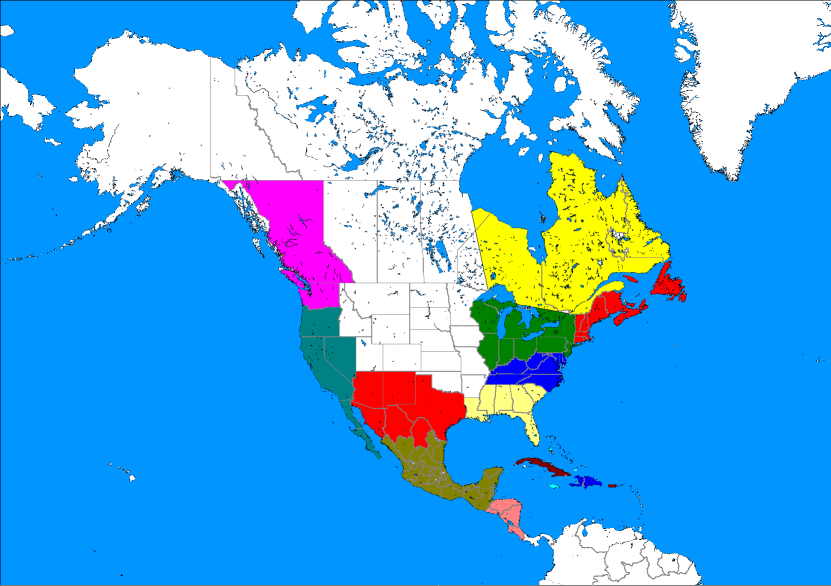
Even if the Convention in 1788 Philly collapses, and the AoC follows shortly after. I don't see every state going its own way. There would be some alliances formed.
So Here is my application of the 9 nation principles.
Obviously the state borders will not be the same, but they will be similar, so usable for Paint/Fill
Whe are starting with a more complete victory in the ARW, so NS, and PEI go with New England. Geographically and Culturally similar.
[Commonwealth of NE]
I figure Pennsylvania will be likly to stick with NY, While Daniel Boone got his reputation leading Pennsylvanian settlers to Kentucky. Here they will be heading to Ohio.
With NY and Philly being 2 of the 3 biggest ports in NA, They will attract most of the westbound Immigrants. [Boston's head north into Maine/NS]
[Federalist States , based on the 1788 attempted Constitution]
I do see a WVirginia, Those 9 Counties, didn't get along well with the Piedmont.
I also think when push comes to shove, NCarolina due to the mountains and the Scots, and the like will go with Virgina, instead of SCarolina.
[Commonwealth of Virginia ????????]
Due to the large number of SCarolina Settlers in Georgia , and the Geography of the entire Gulf region, Georgia goes with SC, and expands west along the coast.
Pre Erie Canal, New Orleans was important to the entire North and Spains messing with Access may be enuff to temporary unite the Alliances.
Spain closed the port in 1803, the war of 1803 reopened it and brought the Delta into the US.
I don't see Georgia and Alabama accepting, the Indian Raids and allowing Florida to be a safe haven for runaway Slaves, so they will move south and take it. ??Timing??
[Still operating on a amended AoC, and consider themselves as the Original US.]
The first Filibustering expedition into Texas was in the 18'oughts, and the Sonora et al. border is obviously based on their winning the Second Mexican/Texas War.
[Republic of Texas --What else]
California had less than 50,000 Mexicans living there when the Gold rush started, It's independence was almost a given.
[Republic of California]
With no 1819 Adams -Otis Treaty with Spain, to set California's north Border, California and British Columbia will have to work that out between them.
I see both BC and California reaching to the Continental Divide, at least.
[Dominion of British Columbia]
While OTL saw Americans with Colonies across the Mississippi by 1812, I just can't predict the Settlement patterns, so I left the centre Blank.
?Does this US win the Greek Wars in the early 1800's? If so Where do the Indians go? South into Spanish Florida, or west. ?Is there a "Trail of Tears" ITTL?
With the British controlling the entire Oregon Territory, ?Will there be a Oregon Trail?
With no Manifest Destiny, and no Homestead Act, ? Do whe still Settle the Great American Desert?,
?What would happen to the Transcontinental Railroad?
And if you don't like my Divisions, go make your own map, it is easy in paint.
Even if the Convention in 1788 Philly collapses, and the AoC follows shortly after. I don't see every state going its own way. There would be some alliances formed.
So Here is my application of the 9 nation principles.
Obviously the state borders will not be the same, but they will be similar, so usable for Paint/Fill
Whe are starting with a more complete victory in the ARW, so NS, and PEI go with New England. Geographically and Culturally similar.
[Commonwealth of NE]
I figure Pennsylvania will be likly to stick with NY, While Daniel Boone got his reputation leading Pennsylvanian settlers to Kentucky. Here they will be heading to Ohio.
With NY and Philly being 2 of the 3 biggest ports in NA, They will attract most of the westbound Immigrants. [Boston's head north into Maine/NS]
[Federalist States , based on the 1788 attempted Constitution]
I do see a WVirginia, Those 9 Counties, didn't get along well with the Piedmont.
I also think when push comes to shove, NCarolina due to the mountains and the Scots, and the like will go with Virgina, instead of SCarolina.
[Commonwealth of Virginia ????????]
Due to the large number of SCarolina Settlers in Georgia , and the Geography of the entire Gulf region, Georgia goes with SC, and expands west along the coast.
Pre Erie Canal, New Orleans was important to the entire North and Spains messing with Access may be enuff to temporary unite the Alliances.
Spain closed the port in 1803, the war of 1803 reopened it and brought the Delta into the US.
I don't see Georgia and Alabama accepting, the Indian Raids and allowing Florida to be a safe haven for runaway Slaves, so they will move south and take it. ??Timing??
[Still operating on a amended AoC, and consider themselves as the Original US.]
The first Filibustering expedition into Texas was in the 18'oughts, and the Sonora et al. border is obviously based on their winning the Second Mexican/Texas War.
[Republic of Texas --What else]
California had less than 50,000 Mexicans living there when the Gold rush started, It's independence was almost a given.
[Republic of California]
With no 1819 Adams -Otis Treaty with Spain, to set California's north Border, California and British Columbia will have to work that out between them.
I see both BC and California reaching to the Continental Divide, at least.
[Dominion of British Columbia]
While OTL saw Americans with Colonies across the Mississippi by 1812, I just can't predict the Settlement patterns, so I left the centre Blank.
?Does this US win the Greek Wars in the early 1800's? If so Where do the Indians go? South into Spanish Florida, or west. ?Is there a "Trail of Tears" ITTL?
With the British controlling the entire Oregon Territory, ?Will there be a Oregon Trail?
With no Manifest Destiny, and no Homestead Act, ? Do whe still Settle the Great American Desert?,
?What would happen to the Transcontinental Railroad?
And if you don't like my Divisions, go make your own map, it is easy in paint.
That has so many cliches, anachronisms, ignoralls of the butterfly effect, and bad borders that it isn't even funny...
one problem with a balkanized NA... all those little nations might be just too tempting to those rapacious European colonial powers....
Share: